

Silicon Valley has spent the last few years obsessing over artificial intelligence. AI that writes code. AI that generates marketing copy. AI that summarizes meetings. Much of it is impressive. Some of it is genuinely useful. But if you zoom out and ask where technology could make the biggest difference in people’s lives, the answer probably isn’t another productivity tool for office workers. It’s something far less glamorous and far more urgent: helping families figure out how to take care of each other.
Because the real breakdown in healthcare today rarely happens inside hospitals. It happens after the patient leaves. That moment when someone walks through their front door with a stack of discharge papers, a list of medications, and instructions that seemed clear in the doctor’s office but already feel confusing at home. Families gather around the kitchen table, trying to make sense of it all. Who’s picking up prescriptions? Who’s driving to the follow-up appointment? Who’s watching for warning signs? And too often, the responsibility quietly lands on one person while everyone else asks the same question: Just tell me what I can do.
For decades, the healthcare system has poured billions of dollars into medical innovation, but one of the most important parts of care has remained largely unsupported: the network of people who care for someone at home. That’s the problem Steve White set out to solve when he built HomeTeams, a platform designed to organize the most powerful and overlooked resource in healthcare—the people who already love the patient.
White didn’t arrive at this idea through market research or venture capital brainstorming. He arrived at it through lived experience. A former football player, he spent years dealing with the long-term consequences of brain injuries, seizures, and autoimmune disease. His own health crisis forced him to rebuild his life from the ground up. Along the way, he developed a philosophy that would shape everything he built afterward: people become stronger when they care for one another.
But the moment that crystallized the idea for HomeTeams came when his parents, Dale and Jane, began needing daily support. Dale had spent his life as a pastor, guiding and comforting people in difficult moments. Jane had worked as a nurse, quietly caring for others behind the scenes. When their health began to decline, the family found themselves facing the same choices millions of families face every year. Institutional care would cost more than $12,000 a month. Managing everything alone seemed nearly impossible.
So White tried something different. Instead of relying on a facility, he organized the people who already cared about his parents. Friends. Neighbors. Members of their church community. Everyone was given a role and a schedule. Responsibilities were shared. Information was clear. What emerged wasn’t just a rotation of helpers but a coordinated team.
The results were dramatic. Monthly costs dropped below $3,000, but more importantly, Dale and Jane were thriving. They were surrounded by familiar faces who cared about them not as patients, but as people. And something unexpected happened to the caregivers themselves. The people helping didn’t burn out. In fact, many of them began doing better in their own lives. One volunteer started exercising again because having somewhere meaningful to be gave him purpose. Others said they felt less lonely and more connected to their community.
Watching this unfold, White realized something the healthcare system had largely overlooked. Caregiving doesn’t break down because people stop caring. It breaks down because there is no shared system that helps people coordinate their care.
Today, millions of families are managing deeply complex caregiving situations through tools that were never designed for them. Group text messages. Phone calls. Sticky notes. Someone volunteers to help but forgets because there was no clear follow-through. Tasks slip through the cracks. And one person—often a daughter or spouse—ends up carrying the entire burden.
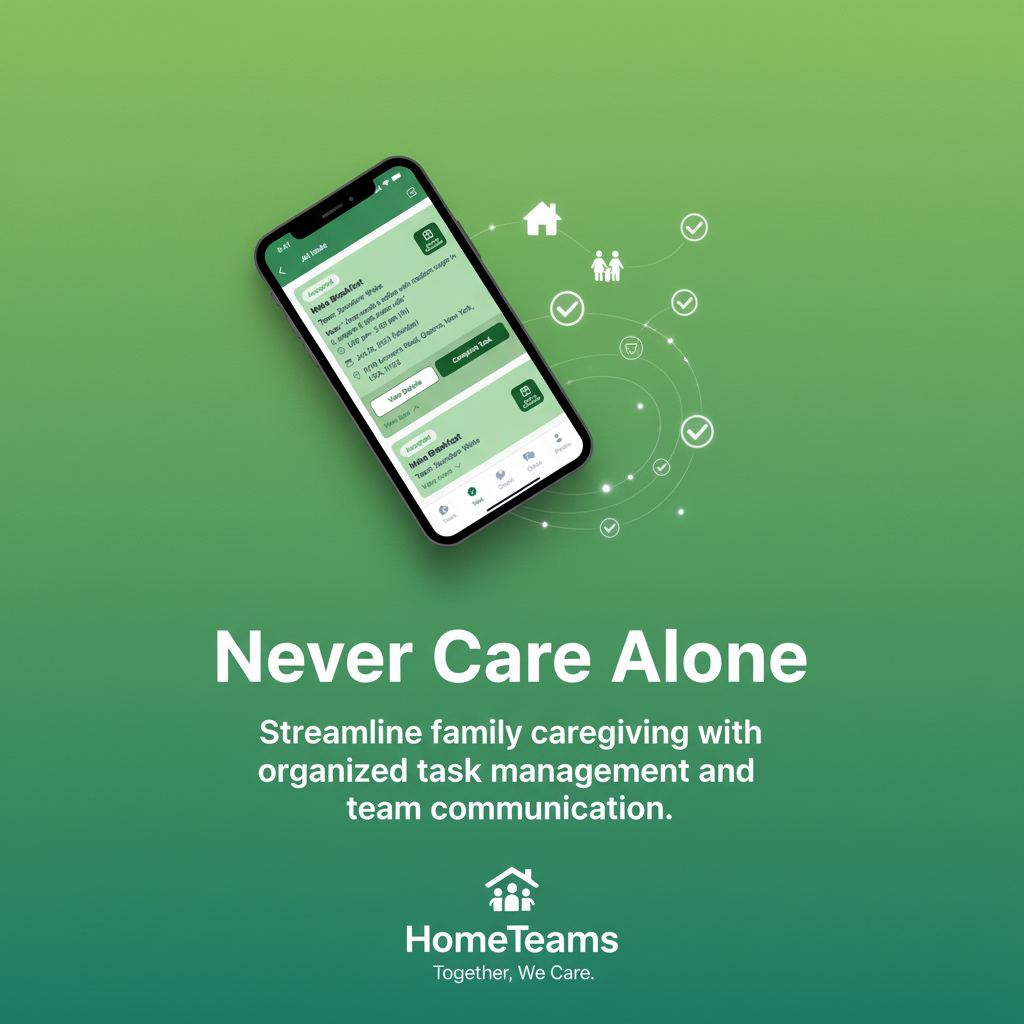
HomeTeams replaces that chaos with structure. The platform allows families to build a care team from anyone they trust: relatives, friends, neighbors, faith communities, and healthcare professionals. Everyone shares the same calendar, tasks, documents, and updates in one place. Instead of scattered conversations across multiple channels, the entire care ecosystem operates in a single coordinated system.
This shift has implications far beyond family convenience. One of the most expensive challenges in healthcare today is hospital readmissions. Patients leave the hospital with instructions and medications, but once they return home, coordination often falls apart. Follow-up appointments get missed. Medications aren’t taken correctly. Warning signs go unnoticed. When the people surrounding a patient are organized and communicating, those failures become far less likely.
HomeTeams also incorporates artificial intelligence in a way that feels refreshingly human-centered. Rather than replacing doctors or automating decisions, Coach AI helps families make sense of complex information. It can capture important details from doctor visits, compare them to past conversations or care plans, and generate summaries that families can actually understand. It can surface trusted research or educational resources related to a specific condition and help teams identify the next practical steps in a care plan. In a world where medical conversations often move faster than families can absorb them, that clarity can make an enormous difference.
Perhaps the most unusual feature of the platform is that it doesn’t just store medical information. It stores context about the person receiving care. What matters to them. What brings them joy. What they want their life to look like. That story travels with the care team, ensuring that everyone involved—from family members to clinicians—understands the human being behind the chart.
The impact extends beyond elder care. Families are using HomeTeams when a new baby arrives and relatives want to help but don’t know where to plug in. Communities are using it to coordinate volunteers for members facing illness or surgery. Chronic illness support groups are using it to prevent caregivers from burning out. The same structure that works for a small family can also support an entire neighborhood or faith community.
Nearly 70 percent of adults over 65 will eventually need some form of long-term care. At the same time, the cost of institutional care continues to rise beyond what many families can afford. Yet most people, if given the choice, would prefer to remain in their homes surrounded by people they know and trust. What has been missing isn’t the willingness to help—it’s the infrastructure that allows that help to function effectively.
HomeTeams is built around a simple belief: the future of healthcare will not be defined solely by hospitals or insurance systems. It will be defined by how well we empower the teams of people already present in someone’s life.
White often sums up the philosophy behind the platform in a single sentence: nobody was meant to do this alone. When care is organized across a team instead of resting on one person’s shoulders, the experience changes completely. The overwhelmed daughter managing everything from two states away suddenly has support. The sibling who wants to help has clear tasks. The neighbor who quietly checks in each week becomes part of a coordinated effort.
Technology doesn’t replace the compassion that drives those relationships. It simply gives that compassion somewhere to land.
And in a healthcare system that has spent decades focusing on institutions, that shift toward organized human care might turn out to be the most important innovation of all.

Whether you’ve been carrying too much for too long or you’ve been on the sidelines wanting to do more, HomeTeams gives you a way in. You can explore the platform and see how it works at hometeams.io. The app is available on the Apple App Store. The person who sets up the team pays one subscription, $29.99 a month or $299.99 a year, and everyone they invite joins at no cost. There’s no cap on team size.
