

At the stroke of midnight on January 1, New York City marked not only the beginning of a new calendar year, but the arrival of a distinctly new political and cultural chapter. Zohran Mamdani was sworn in as mayor in an intimate ceremony held deep beneath City Hall, inside the subway station—a location as unconventional and democratic as the administration he represents. Alongside him stood his wife, Rama Duwaji, whose quietly radical fashion choices immediately reframed what political style can look like in 21st-century New York.
The Ceremony Look: Modern Power Dressing, Rewritten
For the swearing-in, Mamdani placed his hand on a Quran from the New York Public Library’s Schomburg Center for Research in Black Culture, administered by Letitia James. Duwaji held the text, grounding the moment with a visual language that balanced reverence and reinvention.
Styled by Gabriella Karefa-Johnson, Duwaji wore a black vintage Balenciaga coat layered over culotte-style shorts from The Frankie Shop, paired with borrowed boots from Miista. The look was completed with chandelier-style gold earrings from New York Vintage. The silhouette rejected ceremonial stiffness in favor of downtown precision—architectural, expressive, and unmistakably personal.
This was not fashion as ornament. It was fashion as positioning.
A Second Look for the City
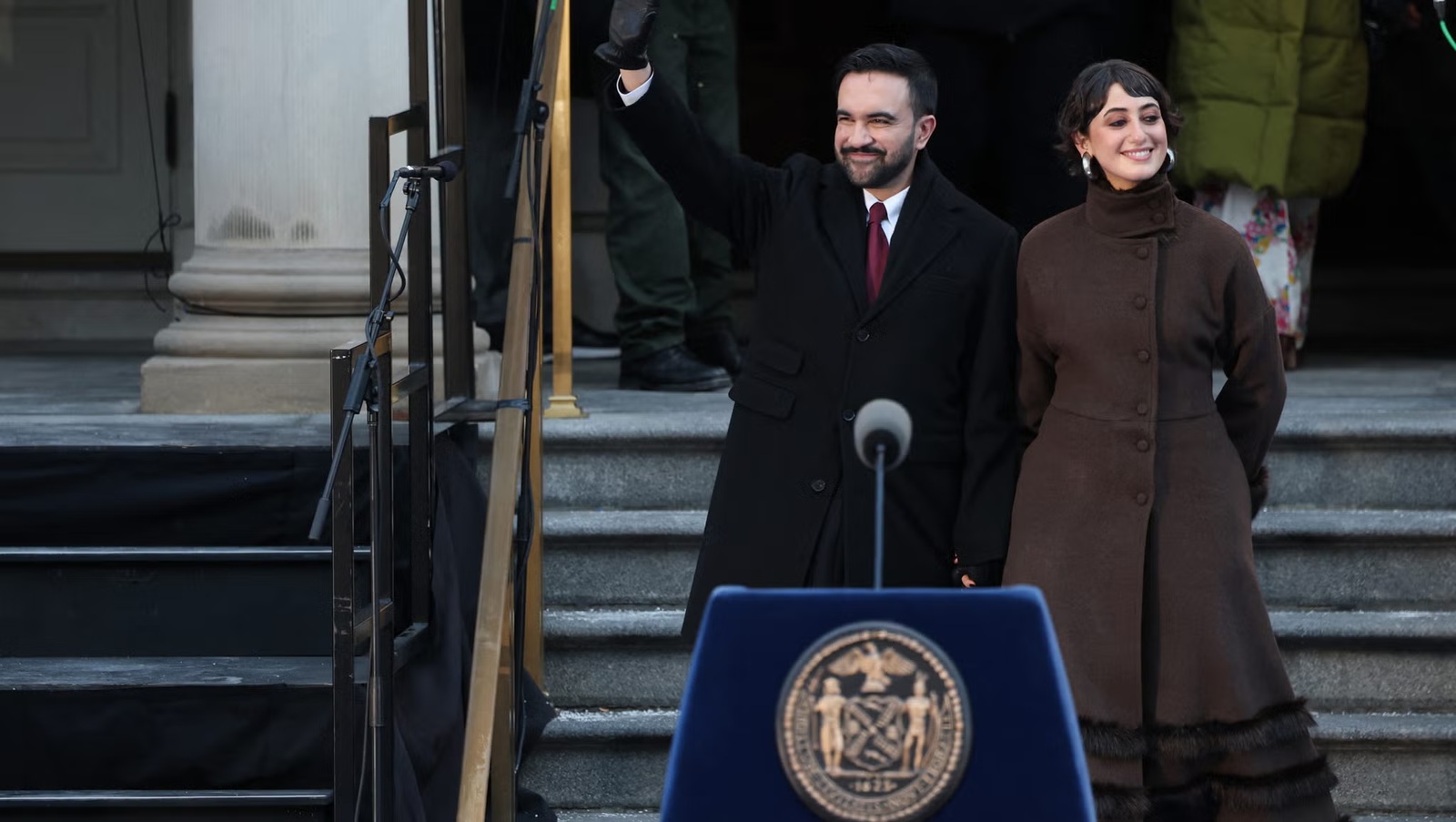
To greet the public following the ceremony, Duwaji changed into a chocolate-brown A-line coat with a funnel neck by Cynthia Merhej, from her label Renaissance Renaissance. The gold earrings were swapped for sculptural silver pieces shaped like thick tusks—bold, organic, and quietly confrontational.
Both looks felt less like “First Lady fashion” and more like what one might wear to an opening in Tribeca, dinner with artists in Lower Manhattan, or a date at a Brooklyn natural wine bar. In that accessibility lies their power. Duwaji’s style mirrors how many Gen Z and millennial New Yorkers actually dress: a preference for black, an embrace of vintage, cropped proportions, and sharp boots ready for city streets and political friction alike.
Fashion as Cultural Signal
Duwaji has been consistent in this approach throughout the campaign. On election night, she wore a laser-cut denim top by Zeid Hijazi, signaling allegiance to independent and politically conscious design. Since then, she has appeared in editorials for New York Magazine’s The Cut and worn local labels such as Diotima, further reinforcing her commitment to New York’s creative ecosystem.
In contrast to the tailored dresses and predictable pantsuits of first ladies past, Duwaji’s wardrobe feels owned, intentional, and unapologetically current. It reflects an administration promising structural change—and a generation unwilling to separate personal identity from public life.
A New Visual Language for Political Optimism
As the United States approaches its 250th year, optimism has often felt elusive. Yet fashion, in moments like this, becomes more than surface-level spectacle. It offers a glimpse of possibility. Rama Duwaji’s inaugural style suggests that leadership can look like the city it serves: diverse, modern, imperfect, and creatively alive.
This was not about breaking rules for shock value. It was about redefining them altogether—and doing so with clarity, confidence, and a very good pair of boots.
